
Hazard Identification & Risk Assessment
Home » Process Safety Management » Process Hazard Analysis » Hazard Identification & Risk Assessment
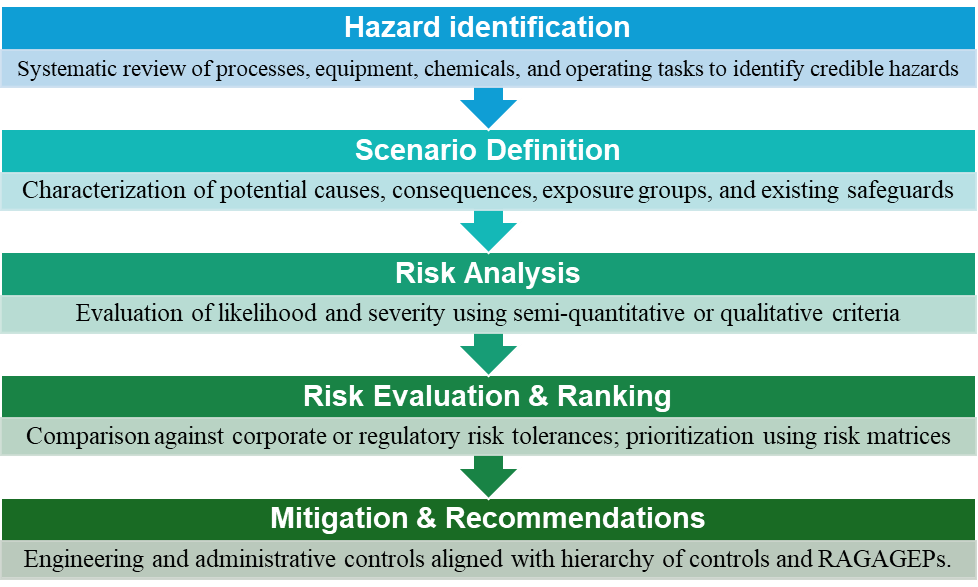
Hazard Identification & Risk Assessment Process flow:
Frequently Asked Questions (FAQ)
1. What is Hazard Identification & Risk Assessment?
2. Why is Hazard Identification & Risk Assessment important?
3. What tools are used for risk assessment?
- Risk matrices
- FMEA
- What-If analysis
- LOPA
- Consequence modelling (fire, explosion, dispersion)
4. What is the difference between qualitative and quantitative risk assessment?
A qualitative risk assessment uses descriptive categories such as Low, Medium, or High to evaluate risk based on expert judgment, experience, and risk matrices. It is fast, requires minimal data, and is commonly used for screening studies like HIRA, PHAs, and safety audits.
A quantitative risk assessment (QRA) uses numerical values to calculate the likelihood and consequences of hazardous events. It relies on detailed process data, failure rate statistics, and consequence modeling tools to produce measurable risk metrics that can be compared to corporate or regulatory tolerances.
In short:
Qualitative = descriptive, relative, quick
Quantitative = numerical, data-driven, more precise
5. How often should Hazard Identification & Risk Assessment be performed?
Typically, every 3–5 years, or whenever there are process changes, incidents, or new hazards identified.