
Root Cause Analysis
Home » Process Safety Management » Process Hazard Analysis » Root Cause Analysis
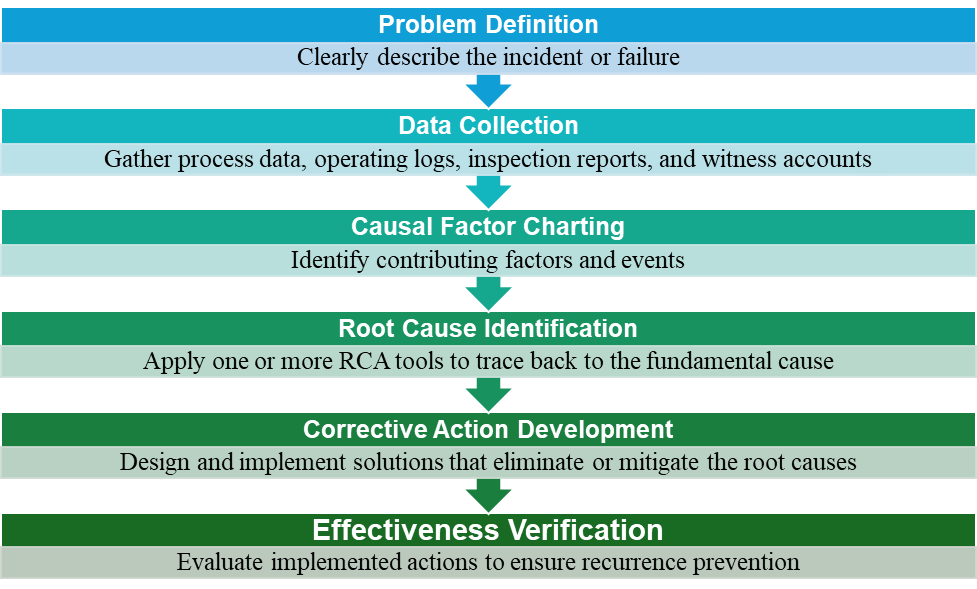
Root Cause Analysis (RCA) is a systematic method used to identify the underlying causes of incidents, failures, or process deviations to prevent recurrence. Instead of focusing on the immediate or apparent cause, RCA aims to uncover the fundamental issues that led to the problem, enabling organizations to implement effective and long-term corrective actions.
Objectives of RCA
Typical RCA Process
Frequently Asked Questions (FAQ)
1. What are the common techniques used in root cause analysis?
- Five Whys Analysis
A simple but powerful tool where the investigator repeatedly asks “why” until the true cause is revealed.
- Fishbone Diagram (Ishikawa or Cause-and-Effect Diagram)
Helps visualize potential causes under categories such as Man, Machine, Method, Material, Measurement, and Environment.
- Fault Tree Analysis (FTA)
A deductive approach that maps the logical relationships between system failures and root causes using Boolean logic.
- Change Analysis
Examine differences between normal and abnormal situations to pinpoint what change triggered the event.
- Barrier Analysis
Evaluates which safeguards failed or were missing that could have prevented the incident.
2. When should RCA be performed?
RCA is typically triggered by significant safety incidents, equipment failures, quality deviations, recurring issues, or near-misses that indicate a systemic weakness
3. What are the industries RCA can be performed?
- Chemical & Petrochemical: Process upsets, equipment failures, and loss-of-containment events.
- Oil & Gas (Upstream, Midstream, Downstream): Pipeline incidents, compressor failures, refinery deviations, and storage tank events.
- Energy & Power Generation: Turbine trips, boiler failures, electrical faults, and system reliability challenges.
- Battery & Energy Storage: Thermal runaway investigations, venting events, material defects, and cell manufacturing deviations.
- Pharmaceuticals & Biotech: Batch failures, contamination events, equipment malfunctions, and quality deviations.
- Food & Beverage: Cross-contamination, process inconsistencies, packaging failures, and utility system issues.
- Manufacturing & Industrial: Mechanical breakdowns, automation issues, human-factor deviations, and product-quality defects.
- Water & Wastewater Treatment: Chemical dosing errors, equipment failures, process inefficiencies, and environmental non-compliance events.
- Pulp & Paper: Boiler issues, production variability, and equipment reliability failures.